


Financing tips
Guide
A guide for international buyers
Financing a property in Mallorca puts foreign buyers before particular challenges. This guide sets out everything that matters about financing through German and Spanish banks, the various financing models and the tax and legal aspects. With our mortgage calculator and practical tips we help you find the best strategy for acquiring your dream property.
Free and without obligation — we get back to you personally.
Request your offerFinancing a property in Mallorca
The basics
German versus Spanish banks: German buyers whose main residence is in Germany can choose whether to finance their luxury property in Mallorca through a German or a Spanish bank. Many German banks offer no direct mortgage on foreign property unless there is sufficient security in Germany (an unencumbered home, for example). That is chiefly explained by their lack of knowledge of the property market and the infrastructure in Mallorca. A few specialised German banks — above all PSD Bank Rhein-Ruhr — do however work in this segment and offer property loans for Mallorca that can be secured by a charge over the Spanish property.
Spanish banks are glad to finance property purchases in Mallorca and accept the Spanish property directly as security. Certain restrictions apply to non-residents (buyers without a Spanish residence). As a rule Spanish banks finance at most 60 to 70 per cent of the purchase price, while 30 to 40 per cent equity is required — plus the purchase costs (taxes, notary, land registry and so on), which are not financed. In practice that adds up to an equity requirement of roughly 50 to 55 per cent of the purchase price. Spanish banks also frequently set an age limit: the sum of the borrower’s age and the term may not exceed 75 years, for instance.
What makes Spanish mortgages for non-residents different:
Spanish mortgage loans differ from the German standard in several respects. While annuity loans at a fixed rate (typically fixed for five to fifteen years) are usual in Germany, Spanish banks frequently lend at variable rates based on the Euribor plus a margin. An annual rate adjustment means that rising interest rates increase the monthly payment. Fixed-rate mortgages do exist, but they are rarer and mostly structured as full-repayment loans — with correspondingly higher monthly instalments.
Typical loan terms and requirements: when financing through a Spanish bank, German buyers should expect the following terms: a maximum loan-to-value of 60 to 70 per cent of the purchase price, terms of 15 to 25 years (exceptionally up to 30 years) and interest rates of around Euribor + 1 to 1.5 per cent. The twelve-month Euribor averaged 2.95 per cent in August 2026 (source: European Central Bank), which currently gives an order of magnitude of about 4 to 4.5 per cent a year, moving with the Euribor. Equity of at least 30 to 40 per cent of the purchase price plus the purchase costs is generally required. German banks with an international arm often offer longer fixed-rate periods (up to ten years) but frequently require additional security in return.
Financing models
The basics
In principle the following models are available for financing your luxury property in Mallorca:
Financing through German banks
a loan is taken out in Germany and secured against domestic assets (a debt-free home, for example). The purchase price is paid in full, so that you appear in Spain as a cash buyer. The advantages are familiar procedures under German law and on German terms, for instance as regards the fixed-rate period. The drawback of this model is that without sufficient security in Germany it is often not workable.
Financing through Spanish banks
on the classic route via a mortgage loan, the Spanish property itself serves as security. The loan-to-value is generally at most 60 to 70 per cent of the purchase price. The advantage of this route is a better assessment of the property’s market value and a process handled centrally in Spain. A disadvantage is often the variable interest based on the Euribor and the need for additional products such as life assurance.
A combination of equity and borrowing
in practice many buyers choose this mixed approach. Typically an existing property in Germany is mortgaged in order to reduce the financing required in Spain. That lowers the loan amount needed, which often leads to better terms.
Tax and legal aspects
for German buyers
When acquiring a property in Mallorca, German buyers have to bear in mind a number of particular tax and legal points:
Transfer tax (ITP)
for resale properties the Balearics apply a graduated scale of 8 to 13 per cent. Each band captures only the part of the value falling within it; the average rate is therefore 10.00 per cent at 1.5 million euros and 11.33 per cent at 3 million euros. The basis of assessment is the higher of the purchase price and the official cadastral reference value. For new builds from a developer, IVA (10 per cent) and stamp duty (AJD) apply instead: 1.5 per cent generally, 2 per cent from a property value of 1,000,000 euros. The details are set out in our guide to taxes and purchase costs.
Annual property tax (IBI)
this is based on the cadastral value of the property and the rate set by the municipality, usually between 0.4 and 1.1 per cent. It is paid to the municipality.
Wealth tax
this is charged only where net assets (property value less mortgage) exceed the allowance. In the Balearics that allowance is 3 million euros per person; owners without a residence in Spain may apply the rules of the region in which their most valuable Spanish assets are situated. The Balearic scale runs from 0.2 to 2.5 per cent on the excess. The tax has to be declared annually in Spain; for very large fortunes the state solidarity tax on large fortunes may apply in addition.
Taxation of rental income
where the property is let, net rental income is subject to income tax of 19 per cent for owners from the EU and the EEA. Since the 2024 tax year the return is filed once a year rather than quarterly as before — for the year 2026 between 1 and 20 April 2027. A tip: many costs are deductible and thus reduce the tax burden. Where no rental income is earned, the non-resident tax applies for that period: 19 per cent on 1.1 per cent of the cadastral value, or on 2 per cent where the cadastral value has not been updated.
Inheritance and gift tax
since July 2023 Balearic inheritance tax no longer applies to spouses, children, grandchildren and parents thanks to a 100 per cent reduction of the tax due; since July 2025 the same applies to gifts to that group. The relief is also open to Germans who do not live in the Balearics. Siblings, nieces and nephews as well as step-children and children-in-law receive 60 or 35 per cent depending on the circumstances. The condition for property: the value stated in the deed may exceed the official reference value by no more than 20 per cent. You must file the return in any event — the relief exempts you from payment, not from the obligation. It also matters that there is no double taxation treaty for inheritance or gift tax between Germany and Spain, so tax may nevertheless fall due in Germany.
Worked examples
and calculations
Our mortgage calculator lets you work through your financing simply, free of charge and without obligation.*
Mortgage calculator
Work through your financing
*This calculator serves solely as non-binding guidance. All results are examples and do not constitute a binding financing commitment. Only the information and contracts of the lending bank are decisive for the granting of credit, the terms and any payment obligations.
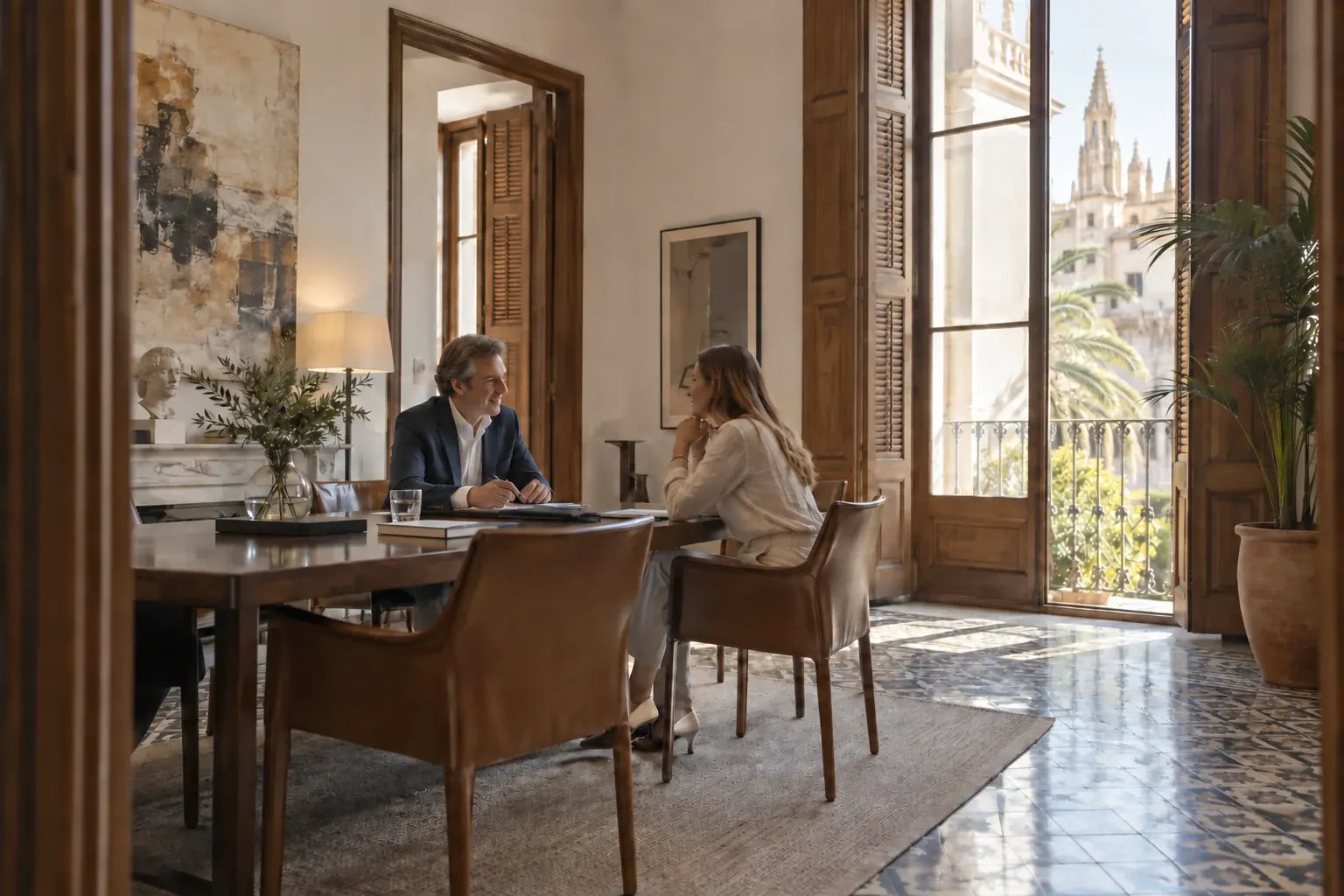
German and Spanish financing compared: German banks (PSD Bank Rhein-Ruhr, for example) often offer fixed rates (say 4 per cent a year fixed for ten years) and work with a classic annuity loan. They frequently require additional security, however, and may finance less than 60 to 70 per cent of the purchase price. Spanish banks, by contrast, offer financing directly on the basis of the property, with variable rates and additional fees being usual.
Financing your property successfully
Advice for Mallorca
Here is some practical advice to make sure your financing runs smoothly:
Choose the right financing partner
compare offers from specialised banks and brokers. Pay attention to the terms, the ancillary conditions and the security required. You should always obtain several offers and bring in a financial adviser to compare them. Always look at the effective annual rate and the ancillary conditions as well.
Set a realistic financing framework
establish early on how much property you can afford and take all the purchase costs into account. It is advisable to plan for sufficient financial reserves so that, alongside the purchase, you can also cover unforeseen expenses such as renovations or periods without guests when letting.
Prepare your documents carefully
assemble all the necessary papers (proof of income, credit record, evidence of equity) to speed up the lending process. Apply for your NIE number early and allow enough time for any translations you may need.
Note local practice and legal differences
find out how a property purchase works in Spain. Open a Spanish bank account for handling the loan and coordinate the notary appointments, including for the execution of the mortgage deed. Take out all the necessary insurance as well.
Avoid the pitfalls
watch out for currency risk and avoid experiments with foreign currencies. Make sure the financing commitment and the contractual deadlines in the purchase contract are aligned. Allow for running costs and rising variable interest rates — both are often underestimated. At best you can protect yourself with an interest rate cap or a partly fixed rate.
Seek legal help
as the buyer you choose the notary, and the notary plays a central part in the transaction. They execute the purchase contract and the mortgage deed and are required by law to inform you beforehand about the clauses of the mortgage financing. At the same time it is advisable to engage a lawyer well versed in Spanish property law. They will examine the contract terms and any charges in the land registry and advise you soundly.
With this advice and information you are well equipped to master the financing of your luxury property in Mallorca — for instance if you would like to buy an exclusive house in the south-west. Plan carefully, get expert support and compare your options, and then nothing stands in the way of the dream of your own home in Mallorca. Every success with your property project.
More guides on buying a house


