


Buying a house in Mallorca
Taxes & purchase costs
Taxes and purchase costs
Have you found your dream property in Mallorca? Then it is time to plan the financing in detail — above all the often underestimated taxes and purchase costs when buying a house in Spain. This guide shows which costs you face, which rates actually apply in the Balearic Islands and how to budget realistically for both.
Free and without obligation — we get back to you personally.
Request your offerTaxes and purchase costs
Overview
Just as at home, taxes and purchase costs arise in Spain when you acquire a property. As foreign banks in particular usually do not include them in a loan, you should be able to cover them from your own funds. In other words, taxes and purchase costs already matter when you select suitable properties on property portals or with an agent. As a rule you have to reckon with the following items:
- Transfer tax on existing properties, or VAT and stamp duty on new builds
- Notary and land registry costs
- Legal and gestoría fees if you have the contract and documents reviewed
- Agency fees for an optional buying agent
On top of that come running costs such as property tax, refuse and street cleaning charges, community fees for apartments and — if your tax residence is not in Spain — the non-resident tax.
Tip: if you do not cover these costs entirely from your own funds, you generally need a separate loan. More on this in the guide to property financing in Spain.
Please note: this page sets out the general legal position and does not replace tax or legal advice in an individual case. Which rates, allowances and deadlines apply to your purchase depends on the property, the price, the use and your personal situation. Have your case reviewed by a Spanish tax adviser (asesor fiscal) or a lawyer.
Taxes when buying a property
in Spain
Which tax arises on a purchase is decided by a single question: are you buying an existing property from a private seller or a new build from a developer? In the first case you pay transfer tax (ITP), in the second VAT (IVA) and stamp duty (AJD). The two never arise together — the taxes are mutually exclusive.
The tax base
The official reference value
Since 2022 a new tax base has applied to transfer tax and to inheritance and gift tax: no longer the purchase price alone, but the valor de referencia — an official reference value which the Spanish land registry derives each year from notarised prices within each valuation zone. Tax is levied on the higher of the two figures.
In practice that means: if the reference value of your house exceeds the agreed price, the tax is based on the reference value — even if you actually paid less. If there is no reference value for a property, or it cannot be certified, the highest of the declared value, the price and the market value applies. You can query the reference value before the purchase through the land registry’s Sede Electrónica; be sure to put it next to your price before signing the deed.
You cannot challenge a reference value you consider too high in advance. It can only be contested by an appeal against the tax assessment or by an application to correct the self-assessment — and then with a valuation report and evidence.
The region of the purchase
A factor in the tax
How high the transfer tax turns out depends heavily on the region, because the Spanish autonomous communities set the rates themselves. There are worlds between the Balearic Islands and the Basque Country, for example. In the Balearics there is also the fact that the rate rises with the value of the property — the more expensive the property, the higher the average rate.
Transfer tax (ITP)
The Balearic bands
For existing properties in the Balearic Islands a graduated scale applies. It works like a progressive income tax: each band applies only to the part of the value that falls within it. The sum gives the average rate (tipo medio), which is then applied to the tax base.
| Property value from | Tax on that amount | Rate on the part above |
|---|---|---|
| 0 euros | 0 euros | 8 % up to 400,000 euros |
| 400,000.01 euros | 32,000 euros | 9 % up to 600,000 euros |
| 600,000.01 euros | 50,000 euros | 10 % up to 1,000,000 euros |
| 1,000,000.01 euros | 90,000 euros | 12 % up to 2,000,000 euros |
| 2,000,000.01 euros | 210,000 euros | 13 % on everything above |
What that means in figures: the overview below shows the transfer tax for typical purchase prices — in each case assuming the price exceeds the official reference value and therefore forms the tax base.
| Property value | Transfer tax | Average rate |
|---|---|---|
| 400,000 euros | 32,000 euros | 8.00 % |
| 750,000 euros | 65,000 euros | 8.67 % |
| 1,000,000 euros | 90,000 euros | 9.00 % |
| 1,500,000 euros | 150,000 euros | 10.00 % |
| 2,000,000 euros | 210,000 euros | 10.50 % |
| 3,000,000 euros | 340,000 euros | 11.33 % |
A common miscalculation: anyone budgeting a flat 12 per cent on 1.5 million euros sets aside some 30,000 euros too much. The top rate always applies only to the part of the value above the relevant threshold, never to the whole price. Garage parking spaces not acquired as an accessory to a dwelling have their own, flatter scale of 8 and 9 per cent.
The Balearics also know reduced rates and exemptions — for instance 4 per cent, 2 per cent or a full exemption on acquiring a first main home up to a value of 270,151.20 euros. One condition is habitual residence in the Balearic Islands in the three years before the purchase. These reliefs do not apply to a holiday or second home.
A new build from the developer
VAT and stamp duty
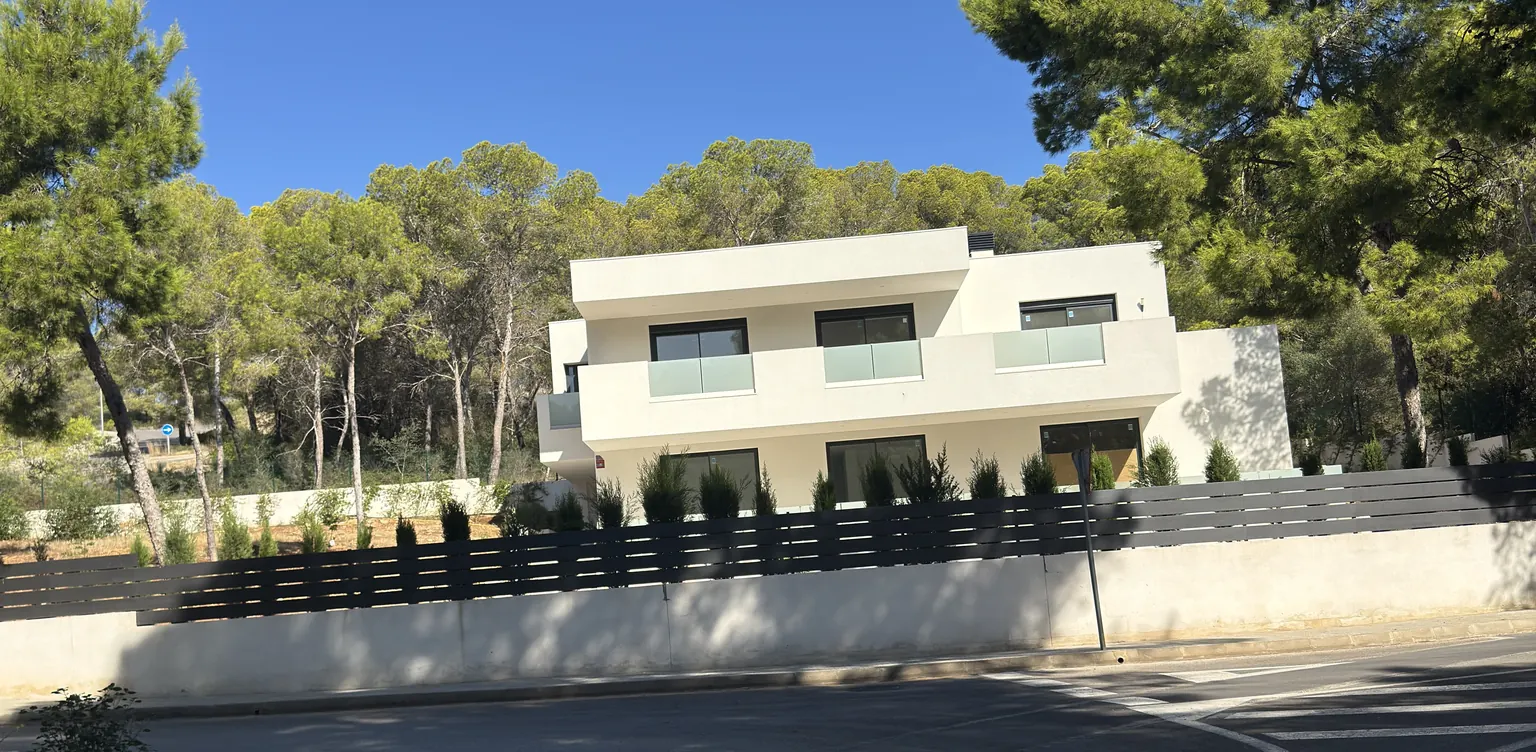
If you buy a new build for the first time from the developer, instead of transfer tax you pay VAT (IVA) of 10 per cent on residential property — plus stamp duty (AJD) on the notarial deed. In the Balearic Islands this is:
- 1.5 % as the general rate
- 2 % from a property value of 1,000,000 euros — the normal case for buyers of higher-value property
- 2.5 % if the VAT exemption is waived on purchase (relevant for commercial buyers)
- 1 % on acquiring a first main home up to 270,151.20 euros
Important for anyone financing: since November 2018 the stamp duty on the mortgage deed has been paid not by the borrower but by the bank. Since June 2019 the bank has also borne the notary, land registry and gestoría costs of the loan; the borrower is left only with the valuation and, if requested, the cost of copies of deeds.
Property tax (IBI)
paid annually to the municipality
Just as in Germany, Spain levies a property tax — the Impuesto sobre Bienes Inmuebles (IBI). The tax base is the cadastral value; the municipality sets the rate. For urban land it moves within the statutory range of 0.4 to 1.1 per cent; surcharges are possible in certain cases. Many municipalities grant reductions for large families, people with disabilities, listed buildings and payment by SEPA direct debit. Ask your future municipality for the actual rate — it differs markedly from place to place in Mallorca.
Non-resident tax
without a main residence in Spain
If you own a house in Mallorca without having your tax residence in Spain, you are taxed on your own use of it. Spain assumes a notional rental value (renta imputada) and taxes it under non-resident income tax (IRNR). The rate is:
- 19 % for taxpayers resident in the EU and in Iceland, Norway and Liechtenstein
- 24 % for everyone else — since Brexit also for owners resident in the United Kingdom
The amount to be taxed is a share of the cadastral value, not of the purchase price. It is 1.1 per cent if the municipality’s cadastral values were generally revised in the current tax period or in one of the ten preceding ones — otherwise 2 per cent. For the years 2023 to 2025 a more favourable transitional rule applied, under which 1.1 per cent already applied if the revision took effect from 1 January 2012.
An example: if the cadastral value is 100,000 euros and the 1.1 per cent share applies, 1,100 euros are taxed at 19 per cent. That gives an annual tax burden of 209 euros. If the property belongs to several people, each files their own return for their share — married couples included.
New deadlines from tax year 2026: until now you could file the return (form Modelo 210) at any time during the following year. For notional rental values from 2026 onwards the window runs only from 1 April to 31 December of the following year — for 2026, therefore, from 1 April 2027. For 2025 and earlier the whole of the following year still applies.
Letting a property
Taxes in Mallorca
If you let your property, the rental income is taxable in Spain — again via the Modelo 210 and at the same rates of 19 or 24 per cent. Owners resident in the EU or the EEA enjoy an important advantage: they may deduct the running costs directly connected with the letting — tradespeople, insurance, community fees, property tax, depreciation and mortgage interest, for example. Only the net income is then taxed. Anyone resident outside the EU and the EEA is taxed on the gross income without deductions.
Non-resident tax and letting are not entirely mutually exclusive. If you let for only part of the year, you are taxed on the rental income for the letting months and pro rata on the notional value for the remaining months. Only with letting all year round does the notional value disappear entirely.
From quarterly to annual: for rental income arising since 1 January 2024, the income of a calendar year is combined and declared once a year — the quarterly return that was previously usual has been dropped. For 2024 and 2025 the window ran from 1 to 20 January of the following year; from 2026 it runs from 1 to 20 April of the following year.
For letting to holiday guests you also need a valid licence. What applies today is set out in the guide buying a house with a holiday rental licence (ETV).
How much tax to expect
What to budget for
The overview below summarises which taxes arise around a house in Mallorca:
Transfer tax (ITP) on existing properties
graduated from 8 to 13 %; the average rate is 8.67 % at 750,000 euros, 10.00 % at 1.5 m euros and 11.33 % at 3 m euros
VAT (IVA) on new builds from the developer
10 %
Stamp duty (AJD) on new builds
1.5 %, and 2 % from a property value of 1,000,000 euros
Property tax (IBI)
0.4 to 1.1 % of the cadastral value, paid annually to the municipality
Non-resident tax (IRNR)
19 % for EU/EEA residents on 1.1 to 2 % of the cadastral value; annually via Modelo 210
Tax on rental income
19 % for EU/EEA residents on the net income; annually via Modelo 210
On a sale
19 % on the capital gain, plus the municipal land value tax (plusvalía municipal)
After completion
Running costs
Once you have acquired your dream house in Mallorca and moved in, the bulk of the purchase costs is settled. What remains are ongoing charges for refuse collection and street cleaning (around 100 to 200 euros a year) and — for apartments and developments with shared property — the community fees. Depending on the facilities these range from around 50 euros a month in a simple development to several hundred euros in properties with a pool, garden, concierge and security. Be sure to ask for these amounts before buying: in upmarket developments they are a considerable permanent item. On top come insurance, electricity, water and the upkeep of garden and pool.
Taxes and purchase costs
A worked example
Two examples show what taxes and purchase costs actually amount to when buying a house in Mallorca. In both cases this is an existing property which the buyer uses personally and for which they do not count as a resident. The transfer tax follows the Balearic scale.
| Item | Price 750,000 euros | Price 1,500,000 euros |
|---|---|---|
| Transfer tax (ITP, graduated) | 65,000 euros | 150,000 euros |
| Notary fees (0.5 to 1.0 %) | 3,750 to 7,500 euros | 7,500 to 15,000 euros |
| Land registry (0.5 to 1.0 %) | 3,750 to 7,500 euros | 7,500 to 15,000 euros |
| Legal fees (1.0 to 1.5 %) | 7,500 to 11,250 euros | 15,000 to 22,500 euros |
| Gestoría | 500 to 1,500 euros | 500 to 1,500 euros |
| Total purchase costs | 80,500 to 92,750 euros | 180,500 to 204,000 euros |
| Share of the price | 10.7 to 12.4 % | 12.0 to 13.6 % |
| Total outlay | 830,500 to 842,750 euros | 1,680,500 to 1,704,000 euros |
An agent’s commission is not included here: in Mallorca the seller usually pays it. Only if you engage your own buying agent does it arise, as agreed. If you finance through a Spanish bank, the valuation (around 300 to 600 euros) and a possible arrangement fee are added — while the notary, land registry, gestoría and stamp duty of the mortgage are borne by the bank.
On top come the ongoing taxes and costs after the purchase. The following example assumes a house with a price of 750,000 euros and a cadastral value of 375,000 euros, which counts as revised under the ten-year rule:
| Item | Cost per year |
|---|---|
| Property tax IBI (0.4 to 1.1 % of the cadastral value) | 1,500 to 4,125 euros |
| Non-resident tax (19 % on 1.1 % of the cadastral value) | 783.75 euros |
| Refuse and street cleaning | 100 to 200 euros |
| Subtotal | 2,383.75 to 5,108.75 euros |
| Community fees (only for apartments and developments) | a further 600 to 3,600 euros |
If you buy a house in Mallorca for 750,000 euros you should therefore expect purchase costs of around 80,500 to 92,750 euros. On top of that come roughly 2,400 to 5,100 euros a year in taxes and charges — plus community fees for an apartment or a property in a development. Insurance, energy, water and the upkeep of garden and pool are not yet included in that.
A short form is enough — we take care of finding the right agent.
Request your offerWhen you sell later
What then arises

Getting out has its price too — and knowing it early makes the calculation more realistic. If you sell a property in Spain as a non-resident, three items arise:
19 % on the capital gain
the difference between the sale proceeds and the acquisition cost is taxed; purchase costs and documented investments increase the acquisition cost.
3 % withholding
the buyer is legally obliged to retain 3 per cent of the agreed price and pay it to the tax office as an advance. If your actual tax is lower, you receive the difference back on application.
Municipal land value tax (plusvalía municipal)
it taxes the increase in the value of the land since acquisition and goes to the municipality. It is calculated either as a lump sum from the cadastral land value and a coefficient based on the holding period, or from the actual increase in land value — the lower amount applies. If it can be shown that there was no increase in value, the tax does not arise. The rate is set by the municipality and may not exceed 30 per cent.
Wealth and inheritance
Balearic particularities

Two further taxes matter for buyers in the higher price segment — and both turn out more favourable in the Balearic Islands than many guides suggest.
Wealth tax (Impuesto sobre el Patrimonio). As a non-resident it covers only your assets in Spain. The national allowance is 700,000 euros; the Balearic Islands have raised it for their territory to 3,000,000 euros. A special rule of the Spanish wealth tax act is decisive here: taxpayers without a residence in Spain may apply the rules of the autonomous community in which their most valuable Spanish assets lie. An owner who holds nothing in Spain but a property in Mallorca can therefore rely on the Balearic allowance. For very large fortunes a national solidarity tax on high wealth also applies; have both levels examined together.
Inheritance and gift tax. For acquisitions on death the Balearic Islands have granted spouses, children, grandchildren and parents (groups I and II) a 100 per cent reduction of the tax since July 2023 — the heirs must nevertheless file the return. Siblings, nephews and nieces (group III) receive 60 or 35 per cent depending on the constellation. For property, one condition is that the value stated in the deed does not exceed the official reference value by more than 20 per cent. Whether Spanish or German succession law applies, and how German inheritance tax relates to it, is a separate question — for that you need advice familiar with both legal systems.
The current legal position
Changes and judgments
Spanish property law has moved considerably in recent years. You should know these points:
New filing deadlines from 2026
the non-resident tax on own use for the year 2026 must be declared only between 1 April and 31 December 2027; rental income for 2026 between 1 and 20 April 2027.
National letting register largely annulled
from 1 July 2025 an additional national registration number obtained through the land registry was to become mandatory for short-term lets. Spain’s supreme court (Tribunal Supremo) annulled the central provisions of that regulation in judgments of 19 and 21 May and 1 June 2026 — including the landlords’ obligations and the registration procedure itself. The Balearic rental licence (ETV) is unaffected: without it, letting to holiday guests in Mallorca remains unlawful.
Hidden defects
in May 2026 the regional court of Palma ordered the sellers of a house in Calvià to repay 6,169 euros because termite damage was only discovered after the purchase and had not been apparent to the buyers. The court treated it as a hidden defect; the sellers had not disclosed an earlier warning from a neighbour. The judgment was not yet final at the time of reporting. It shows why a structural survey before buying is among the most sensible expenditures of all.
Debate about purchase restrictions
in September 2026 the European Commission put forward a proposal for an affordable housing act intended to give regions with strained housing markets — expressly including the Balearic Islands — more scope to intervene. Since then the Balearic government no longer rules out restricting purchases by non-residents. That is not current law: purchases by EU citizens remain freely possible. Those involved expect it would take years for the proposal to become applicable law.
Building without permission
courts in Mallorca regularly order the demolition of buildings and pools erected without a valid permit — even years after a purchase and even against buyers acting in good faith. Checking the building permit, the land registry and the cadastral position before signing the deed is therefore anything but a formality.
Savings
not always a good idea
Looking at the individual items, there is scope for savings at some points. You could do without your own agent, a lawyer and the gestoría in order to reduce the purchase costs. Some buyers who took that route, however, have had poor experiences buying property in Mallorca: the price was far too high, the land was encumbered, or the house had been built without a permit. By relying on agents, lawyers and the gestoría you steer clear of the greatest risks.
Costs and taxes in Spanish
Terminology
Are you searching Spanish property listings for your dream house in Mallorca or leafing through contracts? Then you will usually find no translation. To help you at this point we have gathered the most important terms relating to taxes and purchase costs in Mallorca.
| Term in English | Term in Spanish |
|---|---|
| Official reference value | Valor de referencia |
| Certificate of habitability | Cédula de habitabilidad |
| Income tax | Impuesto sobre la Renta (IRPF) |
| Inheritance and gift tax | Impuesto sobre Sucesiones y Donaciones (ISD) |
| Land registry extract | Nota simple |
| Registration at the land registry | Inscripción en el Registro de la Propiedad |
| Transfer tax | Impuesto sobre Transmisiones Patrimoniales (ITP) |
| Property tax | Impuesto sobre Bienes Inmuebles (IBI) |
| Property value | Valor de la propiedad (property value) Valor de mercado (market value) Valor tasado (appraised value) |
| Purchase price | Precio de compra |
| Cadastral value | Valor catastral |
| Municipal land value tax | Plusvalía municipal (IIVTNU) |
| VAT | Impuesto sobre el Valor Añadido (IVA) |
| Rental income | Rendimientos del Capital Inmobiliario |
| Non-resident tax | Impuesto sobre la Renta de No Residentes (IRNR) |
| Notary | Notario |
| Tax number for foreigners | Número de Identidad de Extranjero (NIE) |
| Stamp duty | Actos Jurídicos Documentados (AJD) |
| Wealth tax | Impuesto sobre el Patrimonio |
Sources and date
Where the figures come from
All tax rates, bands and deadlines on this page come from official sources. Check the position again before deciding on a purchase — the Balearic rates in particular are adjusted through the annual budget acts.
Transfer and stamp duty, wealth, inheritance and gift tax in the Balearic Islands
Decreto Legislativo 1/2014 in its consolidated version (Boletín Oficial del Estado)
Tax base and reference value
Real Decreto Legislativo 1/1993 on transfer and stamp duty
Non-resident tax, rental income, capital gains and the Modelo 210 deadlines
Agencia Tributaria, Sede Electrónica, “No residentes” section
Property tax and municipal land value tax
Real Decreto Legislativo 2/2004 on local finances
Costs of the mortgage loan
Ley 5/2019 on real estate credit agreements
Multilingual, local, vetted — the recommendation costs you nothing.
Request your offerReviewed and last updated on